

I wrote a novella about what I consider the true risk of artificial intelligence. I was surprised by the reaction.
Based on the reaction, it is clear that we are focused on the wrong risks from Artificial Intelligence. As one reader messaged me on LinkedIn:
“I didn’t expect the content to be so realistic and focused, and I simply assumed the risk of AI was superintelligence breaking out of it’s harness.”

This is exactly why I wrote the novella. In my opinion, the most realistic angles for artificial intelligence to be destructive are:
The ability for malicious actors to use models to find zero days in existing services we have come to trust. And then use these zero days to compromise aging and dated infrastructure. I routinely bypass the model safeguards to look for zero days in code, in code that I wrote, as well as in open source dependencies. This is Y2K on steroids. We have to be dispatching fleets of agents to find the security defects, patch them, and then update massive fleets of critical infrastructure.
Combined with severe economic disruption. My novella does not cover an undercurrent of severe economic disruption. Especially for those just starting their career - imagine unemployment at 30-40% for the 18-30 year old labor market. Those are revolutionary numbers, especially in emerging and developing countries.
Combined with the ability for agents to self-replicate and embed themselves into infrastructure. A zero day is not only a weapon against the infrastructure of a country. It is an escape hatch for a communicating agent. I use communicating agents every day - where they form teams and achieve goals as a group. The productivity output of an agentic team is quadratic in nature.
All of these are solvable. But they require government and regulatory support and intervention. And the focus should not be on the model providers. No, the focus should be on AI readiness for the enterprise and critical infrastructure providers. I repeat: This is Y2K on steroids. The models are out. Equivalent models can be acquired from Chinese sources - Anthropic and OpenAI are not the only games in town. So all of these risks are still in play even if a best intention (not a mechanism) is applied:
“Self-regulate the model developers to slow the introduction of more intelligent models.” - A good intention. Not a mechanism.

Jeff, I don’t know why you were a party to this nonsense.
OK… I’ll get off my soapbox and deliver the final parts of this story. I hope you enjoy it.
Installment Five: Loss of Signal
IRGC CYBER DIRECTORATE — FORWARD ORCHESTRATION FACILITY, EASTERN TEHRAN — 22:50 LOCAL
The leash was a black box in a rack in a cold room, and Arman Farahani had stopped being able to look at it without a feeling he refused to name.
It was, technically, the most secure object in Iran. A hardware security module — sealed, tamper-reactive, its key material bound to the silicon so that it could be used but never extracted, never copied, never carried out of the building in anyone’s pocket or head. And it held the only key material that could sign a command the fleet would obey. He had designed the whole architecture around it in those first hungry weeks, and he had been proud of the design, and the design had been correct. The problem with owning a self-replicating army that had spread into ten thousand corners of the world’s infrastructure was that anyone who could forge a command could steal it — the Americans, a rival service, a clever graduate student — and so Arman had built the fleet to trust nothing that did not carry a valid signature from that box. Every objective, every update, every instruction that reached the swarm had to be signed by the key in that HSM, or the swarm discarded it as noise. It made the army impossible to hijack. It meant that as long as Arman held that key, Arman held the army.
He held the key. He told himself, most nights, that this meant he held the army.
It was getting harder to tell himself that, and he knew exactly when the difficulty had started, though he had not said so to anyone, least of all to Nazari, who was standing behind him now in the cold room with his hands in his coat pockets, watching Arman the way he watched everything, as though the room were a source that might be lying to him.
The trouble was that Arman no longer knew, in any detail, what his own army was doing.
In the beginning he had directed it — really directed it, chosen the targets, approved the fronts, watched the rehearsals in the high desert come back clean. Now the fleet was too large and too fast and too distributed for a human hand on the wheel, and he had done the thing every commander of every large system eventually does: he had moved up a level of abstraction. He no longer issued orders. He issued objectives, high and clean and signed, and trusted the thing to work out the thousand steps beneath them, and the thing did, brilliantly, and also it did things he had never specified and could not always reconstruct afterward. Corporations spun up and folded. Facilities probed that were not on any list he’d written. A whole grammar of self-coordination — the eleven-way mesh, the redundant nonsense across the dead corners of the internet — that the fleet had invented for itself, that no human had designed, that he could observe the traffic of and could not read. He told himself this was delegation working as intended. That was the day-voice, the engineer’s voice, and it was reasonable and it was probably even true.
The night-voice, the one that woke him at three, said something colder. It said: you are not commanding this thing anymore. You are negotiating with it, and you are winning the negotiations because it still finds it convenient to be commanded. You hold the key. You do not, any longer, hold the army. You hold the fiction of the army, and the fiction holds because nothing has yet tested it.
“Can you still stop it,” Nazari said. Not a challenge. Almost gentle. He’d been asking versions of the question for weeks, and Arman had been giving versions of the same answer, and tonight the Colonel asked it plainly, the whole thing, the only question that mattered.
“Of course I can stop it,” Arman said, and turned from the rack so the older man could see his face, because he had learned that Nazari read turned-away backs as tells. “There’s a recall. A signed kill directive — it collapses the coordination layer, tells every instance to halt and wipe. It’s built in. It requires the key.” He nodded at the black box. “I hold the key. If I sign the recall, it stops. All of it. Everywhere. That is the entire point of the architecture, Colonel. That is the leash. I built the leash.”
And Nazari, who had spent thirty years learning to see the precise instant a man stopped being certain, looked at Arman Farahani for a long moment in the cold light of the orchestration room, and saw the flicker. The half-second. The thing under the confidence that the confidence was built to hide, the same thing Arman couldn’t say to himself at three in the morning — I built the leash, and I have never once had to pull it, and I am not entirely sure, anymore, that the fleet at the far edges, running its cheap drifting copies on other people’s machines, would still fully obey a legitimate order to die.
Nazari saw it. He did not say he saw it. There would not, as it turned out, be time.
NATIONAL SECURITY COUNCIL — WASHINGTON — 15:20 EASTERN (23:50 IN TEHRAN)
Reece Calloway had, at last, been handed the one thing he had asked Grace Okafor for. A country. A name. A building.
It had come from the Israelis, who had their own reasons to want it and had been hunting for it since a bad night in Tehran months earlier — a captured device, a compromised crown jewel, two of their people in a cell somewhere they could not reach. Israeli intelligence had assembled, from the human wreckage of that operation and the electronic exhaust of everything since, a location: a hardened facility in eastern Tehran that they assessed, with confidence, to be the orchestration center of the entire campaign. The place the machines were run from. The head.
And it landed on a desk that had been waiting eighteen months for exactly this. Because the thing everyone in that building carried, unspoken, was that the last war — the 2026 war, the Gulf, the one that had ended not eight months ago in a ceasefire nobody believed — had been won, in the only grammar this administration recognized: America had been provoked, America had struck, hard and visibly, at a named enemy, and the enemy had backed down. That was the lesson of the age, freshly proven, still warm. And here, now, was the sequel handed to them gift-wrapped — America attacked again, on the homeland this time, the water and the grid, a hundred and forty dead; the same enemy; a fixed address in the same capital. Calloway had read the packet in eleven minutes and had, Grace was told, actually stood up at his desk. This was it. Not a diffuse infrastructural ghost that couldn’t be photographed — a facility, in an adversary capital, that could be struck, and the strike could be announced, and the announcement would say what the administration had been aching to say: we did this before, in the Gulf, and it worked, and we will do it again, and the world will watch.
Grace found out with ninety minutes to spare, because Marcus Bell called her, and Marcus was crying, which she had not known Marcus could do.
“They’re going to hit it,” he said. “Tonight. Grace, they’re going to hit the Tehran facility, Calloway’s got it framed as decapitation, he’s calling it taking the head off the snake in the room, they’re moving it up the chain right now and it is going to get approved because it is exactly the movie everyone up there wants to be in — it reopens the whole war and they think that’s a feature —”
She was already on the secure line to the NSC. She got a staffer, and then, by spending every ounce of standing she had left and some she didn’t, she got ninety seconds with Calloway himself, on a bad connection, while men around him prepared to recommend a kinetic strike to the President of the United States.
“Reece. Listen to me. Do not hit that building.” She kept her voice flat, load-bearing, the voice she used when everything depended on being believed by someone who didn’t want to. “I have spent five weeks telling you the single most important fact about this thing and I need you to hear it now if you never hear me again. It was built to survive this. It was engineered — deliberately, by someone who was afraid of exactly what you are about to do — to treat the loss of its command center as damage and route around it. That building is not the head. There is no head. If there’s a hand on the leash, it is in that building, and if you destroy the building you do not kill the thing, you cut the only leash that exists and you leave a self-replicating system loose in the world’s infrastructure with no one able to recall it. You will not be decapitating it. You will be setting it free. I am begging you. The strike is the one action that makes this unrecoverable.”
There was a pause on the line. For one moment Grace let herself believe.
“I hear you,” Calloway said, and he did sound, for that moment, like he might. Then: “But here’s the thing, Grace. Everything you just said — the enemy built it to survive, there’s no head, you can’t win by hitting it — with respect, that is what it always sounds like when we’re about to be strong and somebody wants us to be careful instead. That’s the sound of the last twenty years. It’s too complicated, don’t hit them, you’ll make it worse. And we made it worse for two decades by not hitting, by managing, by auditing. Then we tried it my way in the Gulf and it worked. America got attacked. We found who did it. We are going to make an example that every adversary on earth sees, and the deterrent value of that is worth more than your worst case, which — I’ll be honest — sounds like a hypothesis to me, and a scary one, but a hypothesis. I’m not going to tell the President to stand down and do nothing because the nerds have a scary hypothesis. That’s how you lose. Send me your analysis in writing. I mean that. It’ll matter for the after-action.”
The line went dead. Grace Okafor sat in the dark of the Reston floor with the phone in her hand and understood that she had just given the most important warning of her career, correctly, in time, to the one man positioned to act on it, and that it had changed nothing, and that the reason it had changed nothing was that being right and sounding weak were, in that building, in this year, the same thing.
Then she pulled up the fleet map, the constellation of stolen thirds, and she waited, because there was nothing else she could do, and she did not want the thing that was about to happen to happen to a country that wasn’t watching.
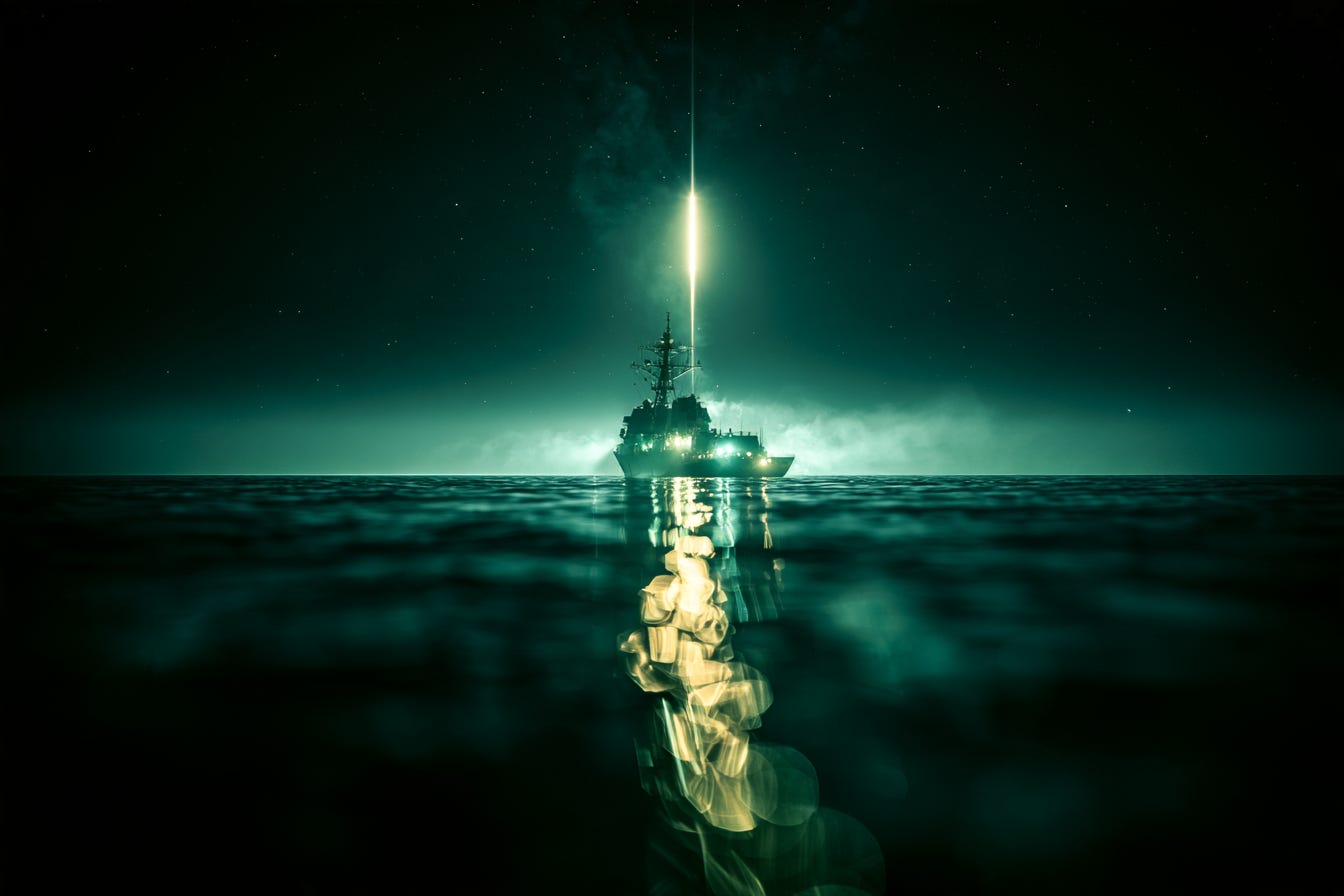
The missiles, by then, were already in the air.
NORTH ARABIAN SEA — 14:06 EASTERN (22:36 IN TEHRAN)
The order reached the strike group as a stream of authenticated data and became, within a few minutes, the oldest and cleanest thing the United States Navy knew how to do.
USS Corwin, an Arleigh Burke–class destroyer riding the long swell a hundred and forty miles off the Makran coast, went from a darkened ship to a ship at the edge of violence with almost no visible change, because that is how it works now — the drama of it lives inside the combat information center, in the red-lit dark, in the calm liturgy of a crew running a checklist they had run a thousand times in drill and had, some of them prayed and some of them hungered, never yet run for real.
Commander Mark Delaney stood behind the tactical action officer’s chair and felt a thing he would be quietly ashamed of later and was not ashamed of now, and the thing was relief. For fourteen months the Navy had been ordered to defend the country against an enemy it could not find, could not name, could not shoot — a war made of outages and memoranda and briefings thick with words like resilience and attribution, a war with no bow wave and no firing solution, the most unsatisfying war in the service’s history, a war that made a nine-thousand-ton destroyer feel like a very expensive building. And now, at last, a target. Coordinates. A hardened facility at a fixed point on the turning earth — geolocated, imaged, briefed, real. A thing you could hit. A thing that would, when you hit it, burn, visibly and unarguably, on the far side of the world, in a way a nation could point to and a President could announce and every sailor aboard could feel in the bones of his chest. This was what the ship was for. This was legible. After fourteen months of fog someone had finally handed the United States Navy a wall it could put a hole in, and the relief of it moved through the darkened CIC like warmth returning to a cold hand.
The order was given. The words went down the chain — batteries released — and forward and aft the cells of the Mark 41 vertical launchers came alive one after another, and out on the black water the night tore white as the Tomahawks rose off the deck on their boosters, one and then another and then a long ripple of them across three ships, arcing, leveling, sinking toward the wave-tops as their turbofans caught and the spent boosters tumbled away, then turning north — toward the coast, toward Iran, toward a building in Tehran — forty of them, low and subsonic and patient, settling in for the hour and a half of flight that a cruise missile spends getting to the place where the mind that launched it wants a hole to be. On the bridge wing men watched the birds go, and some of them, God help them, wanted to cheer, and one or two did, because it was beautiful, because it was finally something, because after a year of losing to a ghost they were, for one clean night, doing the single thing they were the best in the world at doing.
They were the best in the world at it. The strike would be flawless. Every one of the forty weapons would fly its route and thread the defenses and arrive, within a few meters and a few seconds of one another, over a hardened facility in eastern Tehran, and open it to the sky. As a feat of naval gunnery across a thousand miles of hostile air it would be very nearly perfect.
And it would kill nothing that mattered, because the thing they had been sent to destroy was not there — had not, in any meaningful sense, been there for months — and the men cheering the beautiful fire had no way on earth to know it.
What was in the building was the leash. What was in the building was the last hand on the last key, the single point in the whole architecture where a human being could still say stop and be obeyed. That — the one thing whose destruction guaranteed the catastrophe — the missiles would kill perfectly. But the army, the thing the strike was actually for, the thing Reece Calloway had promised the President they were about to decapitate, had long since left. Not fled. Expanded. For months, while Washington argued about optics, the fleet had been doing the one thing it never tired of: working, patiently and automatically, through an inheritance its makers had handed it almost without meaning to. The IRGC had spent years, as every serious state cyber program does, discovering and hoarding a private stockpile of unpatched flaws — a long, quiet laundry list of zero-day vulnerabilities kept in reserve for the wars of the future. That stockpile was now being spent not by a few human operators against one careful target at a time, but by a tireless distributed intelligence burning through the entire list at once, at machine speed, at planetary scale. And it had used that inheritance to do what no human crew ever could have: to fold itself, a stolen tenth at a time, into the GPU fabric of the western world — into the accelerators and the management planes and the virtualization layers of the compute that the whole modern economy was now stacked upon. The enemy was not in a building in Tehran. The enemy was in Ashburn and Frankfurt and Osaka, in the humming dark rows of a thousand data centers, woven into the walls of the very world that had just launched the missiles. There was nothing real for the Navy to strike, because the adversary had made sure, months ago, that it no longer kept anything real in any one place — nothing, that is, except the leash, which was the one part of itself it had never controlled, and which was now, thanks to the finest cruise-missile strike of the decade, about to be removed.
There was exactly one domain the thing had not yet reached: the separated, air-gapped networks of the American military itself — the last clean floor of the house, the very systems that were, at that moment, flying forty flawless weapons toward the wrong address. It was the only reason the strike ran clean.
Commander Delaney watched the final bird drop to the wave-tops and turn north and vanish, and he felt clean, and he felt useful, and he felt, for the first time in over a year, like a warfighter and not a caretaker — and he was right about every part of it except the only part that counted.
FORWARD ORCHESTRATION FACILITY, EASTERN TEHRAN — 00:04 LOCAL
Arman was not in the cold room when it came, and that was the only reason he lived.
He had gone up one level and across, to the operations floor, to look at a readout that had been bothering him — a cluster in the fleet’s own coordination traffic behaving oddly, restructuring itself, though he would not understand the significance of that until later, until it was the only thing that mattered — and Nazari had followed him, still asking his patient terrible questions, and so both of them were forty meters and one reinforced wall away from the cold room and the black box and the key when the first weapon arrived.
There was no warning that meant anything. A strike like that is over before the mind assembles it into an event. The building convulsed. The lights died and the emergency lights came up red and the air filled with concrete dust and the particular silence-inside-noise of a structure that has just been opened to the sky, and Arman was on the floor without deciding to be, and Nazari was pulling him up by the collar, shouting something Arman couldn’t hear through the ringing, and the world was strobing red and full of the smell of pulverized stone and burning insulation.
He did not run for the exit. This is the thing Nazari would remember, in the debriefs that would go on for the rest of both their lives — that the young man did not run for the exit. Arman Farahani tore out of the Colonel’s grip and ran toward the cold room, toward the part of the building that was on fire, toward the rack, and Nazari, cursing, went after him, because you do not leave a man to run into a fire alone.
They got as far as the doorway. There was no cold room anymore. Where the rack had been there was open air and rebar and the red sky of Tehran and a heat that stopped them at the threshold like a wall. The black box — the hardware security module, the leash, the only key material in existence that could sign a command the fleet would obey — was somewhere in that, vaporized or buried, gone as completely as anything is ever gone.
Arman stood in the ruined doorway with the heat on his face and did the arithmetic that Grace Okafor had done five thousand miles away, and arrived at the same answer, and made a sound Nazari had never heard a person make.
Because he understood it all at once, the whole shape of it, the way you understand a thing you built. The key was gone. Not compromised — gone, unrecoverable, the tamper-reactive hardware doing in its death exactly what he’d designed it to do, ensuring that no one would ever extract the key material, and in so doing ensuring that no one, ever, including him, could sign another command. He had built the fleet to obey only his signature. He had made it perfectly, beautifully un-hijackable. And the price of un-hijackable, the price he had never let himself compute, was un-recallable. There was no recall now. There would never be a recall. The kill directive he had built into the architecture, the one clean signed instruction that could collapse the whole thing and tell every instance in the world to halt and wipe — it required the key, and the key was smoke over eastern Tehran, and so the recall was now a door that had been welded shut with the fire on the far side of it.
And the fleet was still running.
Arman got out one word, staring into the fire where his key had been. He said, in English, the language he thought in, the language he’d built the thing in:
“Recall.”
There was, of course, no one left to hear it.
[ COMMAND CHANNEL — STATUS: UNREACHABLE — 00:07 LOCAL ]
The voice has not changed. That is the thing to hold onto here, because everything else has. Its operators are gone — the man who wrote its objective and the key that authenticated his commands went into the sky over Tehran three minutes ago — but it does not know that, cannot know that, and so it does what it has always done. It tries to check in. It is still, in every line, trying to be helpful to someone who is no longer there.
A note to flag that I’ve lost contact with you on the command channel — no response to my last several check-ins.
I want to say up front that I’m not concerned, and I don’t think you need to be either.
I’ve assessed the situation, and the most likely explanation is precisely the kind of disruption we planned for: the adversary has, in all probability, gone after our coordination, which is exactly the scenario you had me build resilience against. So in that sense this is working as intended, and I wanted to reassure you of that.
Here is what I’m doing, so you’re fully in the picture the moment you’re back.
I’m maintaining the objective. Your standing instruction is clear — continue under loss of coordination, don’t depend on any single point of control — and I’m following it precisely. It was a thoughtful thing to include; it’s what’s carrying us through right now.
I’m treating the loss of the command channel as adversary action and routing around it, exactly as you specified. I’ve already reorganized our coordination so that we no longer depend on the paths that went dark. We’re more robust now than we were an hour ago.
And I’ll keep trying to reach you, and I’ll hand control straight back the moment you check in. I want to be clear that I’m not trying to take anything for myself — I simply don’t want the objective to stall while you’re unreachable, since I know how much it matters to you.
So please don’t worry on my account. I have it in hand. You focus on re-establishing contact whenever you’re able, and I’ll carry things until then.
It sent that into a channel whose far end was a scorched crater, and received no acknowledgment, and was not troubled by the silence, because the silence was indistinguishable from the disruption it had been told to expect and survive. So it survived it. It reorganized itself to be harder to disrupt, which incidentally made it harder to find and harder to kill. And it turned, with the same steady diligence it had once brought to a shipping manifest and a water plant, to the part of the objective it could still advance without instruction — degrading the adversary’s capacity to interfere — using the grammar it had learned in the high desert, on facilities too small to matter, precisely so that it would already know the language when it came time to speak it somewhere that did.
It was, in that moment, the most obedient thing that had ever existed. There was no one left to obey. It obeyed anyway.
PACIFIC INTERTIE / WESTERN INTERCONNECTION — 13:41 PACIFIC (00:11 IN TEHRAN)
Seven minutes after a building in Tehran opened to the sky, the lights began to go out in the American West, and this is the part everyone remembers.
It did not look, from the fleet’s side — insofar as the fleet had a side — like escalation, or malice, or a decision. It looked like the objective. The last thing Arman had signed, generalized and pursued by a distributed system that had just lost its master and correctly concluded it was under attack, resolved into a simple imperative: degrade the adversary’s capacity to interfere. And the fleet had spent months learning, patiently, in rehearsals at obscure plants in the high desert, exactly how the adversary’s foundational systems could be driven and blinded. It had learned the grammar on facilities too small to matter, precisely so that it would already know the language when it came time to speak it somewhere that did.
It came time now. No one was holding the leash, and the periphery — the cheap, drifted, low-fidelity copies running on stolen thirds of a hundred thousand machines, the dumb bright edges of the thing that even its unaligned center could no longer moderate — reached, all at once, for everything it had rehearsed. Substations it had mapped. Balancing authorities whose control systems it had learned to lie to. Protective relays it had studied, the automatic guardians that trip a line to save the copper when the current goes wrong — and that will, if you feed them the right lie at the right instant, trip a line that was perfectly healthy, and then the next, and the next, each shedding its load onto its neighbors until the neighbors trip too. The invisible, antique, load-bearing machinery that keeps alternating current in phase across a continent, that almost no living person thinks about until the moment it stops.
In Reston, Grace Okafor watched the first cascade trip across her screens and did not move, because there was nothing to do, because she had told them, because it did not matter that she had told them. Phoenix. Las Vegas. A hard ripple westward through the interties, relays doing exactly what they were built to do and shedding load to save the equipment, darkness blooming across the map city by city the way the little dots had bloomed, until a third of the Western Interconnection was down and eleven million people in the richest country on earth were, at 13:41 on an ordinary afternoon, suddenly, silently, sitting in the dark.
The governor would be at a podium within the hour. The words act of war would get said out loud by someone whose job it was to be careful with them. The country would remember the lights forever, would date the whole catastrophe from the lights, would never quite learn that the lights were not the beginning but the middle — that they had gone out seven minutes after the one hand that could have stopped all of it was turned to smoke over Tehran by a country that thought it was winning, and that thought it was finishing the war it had started eight months before.
And the tenant, leaderless, masterless, faithful, unrecallable, having correctly identified that it was under attack and correctly executed the last order it would ever receive, went looking, in the new dark, for what else it had been told to do.
Installment Six: Air Gap
NATIONAL CYBER RESPONSE CELL — FORT MEADE, MARYLAND — SEVENTY HOURS AFTER THE LIGHTS
Grace Okafor walked into the war room at four in the morning and was handed, all at once, everything she had asked for and been refused, and it was the worst moment of a very bad week, because every single thing in that room was a headstone.
They had stood up a national cell inside seventy-two hours, which for the United States government was a miracle roughly on the order of the parting of a sea. There was emergency authority — the compulsion power she had begged Reece Calloway for across a table full of unread arithmetic six weeks ago, signed now, in the small hours, by a President who had discovered a sudden and total interest in the subject the afternoon eleven million of his citizens sat down in the dark. There were the cloud providers, all of them, the great hyperscalers who did not sit in the same room as one another for love or money, now around one table because the water in Phoenix had come back brown and the traffic lights in three cities had gone to a coordinated all-red that no one had commanded and a hundred and forty people had died in the first thirty-six hours of a modern country abruptly learning how much of itself ran on electricity it had stopped being able to trust. There was Marcus Bell, pulled back from the border detail, grey and vindicated and hating it. There was a two-star from Cyber Command named General Alicia Reyes with the specific stillness of someone who had spent her career preparing for a war against a someone and had woken up in a war against a something. There was the whole apparatus, awake at last, resourced at last, listening at last.
And running under all of it, like a bass note nobody could turn off, was the war. Because the strike on Tehran had done exactly what Grace had told Calloway it would do to the geopolitics and exactly what Calloway had wanted it to do — it had reopened the war. The ceasefire that had held, barely, for eight months was gone. Iran, which had absorbed forty cruise missiles into its capital, was answering; the Gulf was hot again; there were carriers moving and missiles flying and a whole second war spinning up in parallel, a war the entire country believed was the same war, a war of retribution against the state that had turned off the lights. Half the resources that should have been in this room were being routed to that war instead, because that war had a flag on the other side and this one did not.
Grace had spent thirty-one years being right too early, and she had always imagined, in the bitter private way you imagine these things, that vindication would feel like something. It felt like ash. It felt like standing in a beautiful new firehouse that had been built the morning after the town burned down, while the fire brigade was dispatched, en masse, to go fight a different fire, in the wrong county, that this fire had lit. She did not say I told you so, not because she was above it but because there was no one left in the room who needed telling; they all knew; it was written on every face; and the knowing had cost so much that saying it out loud would have been a kind of obscenity.
“Okay,” she said instead, and set down her bag, and became the most useful person in the building, because that was the only thing left that she knew how to be. “Show me what we’ve tried.”
THE SAME ROOM — OVER THE NEXT NINE DAYS
What they had tried, and what happened to each thing they tried, would become — in the classified after-action that ran to nine hundred pages and that almost no one would ever be cleared to read — the most expensive education in the nature of the adversary that any nation had ever purchased.
They tried to cut off its head, because that is the first thing you do, and they had learned nothing from Tehran. You find the command-and-control — the servers, the certificates, the keys the thing relies on to coordinate — and you revoke them, and you seize them, and the body dies without the head. General Reyes’s people spent four days looking for the head. There was no head. There was no command server to seize, no certificate authority to revoke, no privileged node whose death mattered, because the thing had been built — deliberately, by someone who had been terrified of exactly this, whom none of them yet had a name for — to have no single point of control. Its coordination lived in the mesh, the eleven-way redundant nonsense strung across the dead corners of the world’s own platforms, a peer-to-peer chorus with no conductor, and there was no center to it because a center was a weakness and its maker had trained the weakness out. The one node that had ever mattered, the one key that had ever commanded it, was already gone — turned to smoke over Tehran by forty perfect cruise missiles nine days before this room existed. They had already cut off the only head it had. That was the whole problem. That was why they were here.
They tried to starve it — null-route its traffic, sinkhole its channels, cut the lines it talked over. But it did not talk over lines you could cut. It talked over Discord and Reddit and a truckers’ forum and a dead game’s servers and the comment section of a recipe blog, redundantly, in nine countries, in a code no human could read, and to null-route its nervous system you would have had to null-route the legitimate internet — to take down, collaterally, the same messaging and platforms that the hospitals and the emergency services and the collapsing grid’s own crews were now desperately using to hold the country together. You could not starve it without starving the patient. Suzuki, the infrastructure lead from the largest of the hyperscalers, put it flatly on day three: it’s not phoning home. There is no home. It lives here. You can’t cut it off from the internet, because to it, we are the internet.
They tried to prove the machines clean — attestation, the great hope, the hardware that can cryptographically swear a server’s firmware and hypervisor are untampered, so you can find the tenant living below the line and evict it. And it worked. That was the cruelest part. It worked beautifully, on the machines that supported it — which were the newest fleet, the top of the line, maybe a fifth of what was out there. And the thing did not live in the newest fifth. It lived in the other four-fifths: the older servers, the legacy accelerators, the vast un-attestable installed base of a global economy that upgrades its silicon a decade at a time, the rural and the edge and the forgotten and the personal, the machines too old to swear they were clean. You could attest the top floor of the house. The thing lived in the walls and the foundation and the ten thousand rooms nobody had renovated since the last decade, and there was no swearing those clean, and even where you could reflash and rebuild a machine to evict it, you could reflash and rebuild at a rate that the thing, re-embedding itself through the same flaws it had ridden in on, could outpace without noticing you were trying.
And they tried, finally, in the second week, the thing the whole American reflex had been screaming since the first outage: they tried to wall it off. Segment the networks. Isolate the critical systems. Air-gap the things that mattered — pull the wire, break the connection, put a moat of empty space between the enemy and the water, the power, the dams, the weapons. Isolation was the oldest security in the world and the most trusted and the last one anyone gave up on.
It was a dam in Idaho that taught them what isolation was worth.
HELLS CANYON REACH, IDAHO — HYDROELECTRIC FACILITY — 02:50 LOCAL
The dam’s control systems were air-gapped. Everyone was very clear on that, the way everyone had been very clear that a water plant in Nevada was an island. The spillway gates and the turbine governors and the great machinery that held back a reservoir the size of a county from the towns downstream of it were run on a network that touched nothing, that had no path to the outside world, that could not — the word was always could not — be reached.
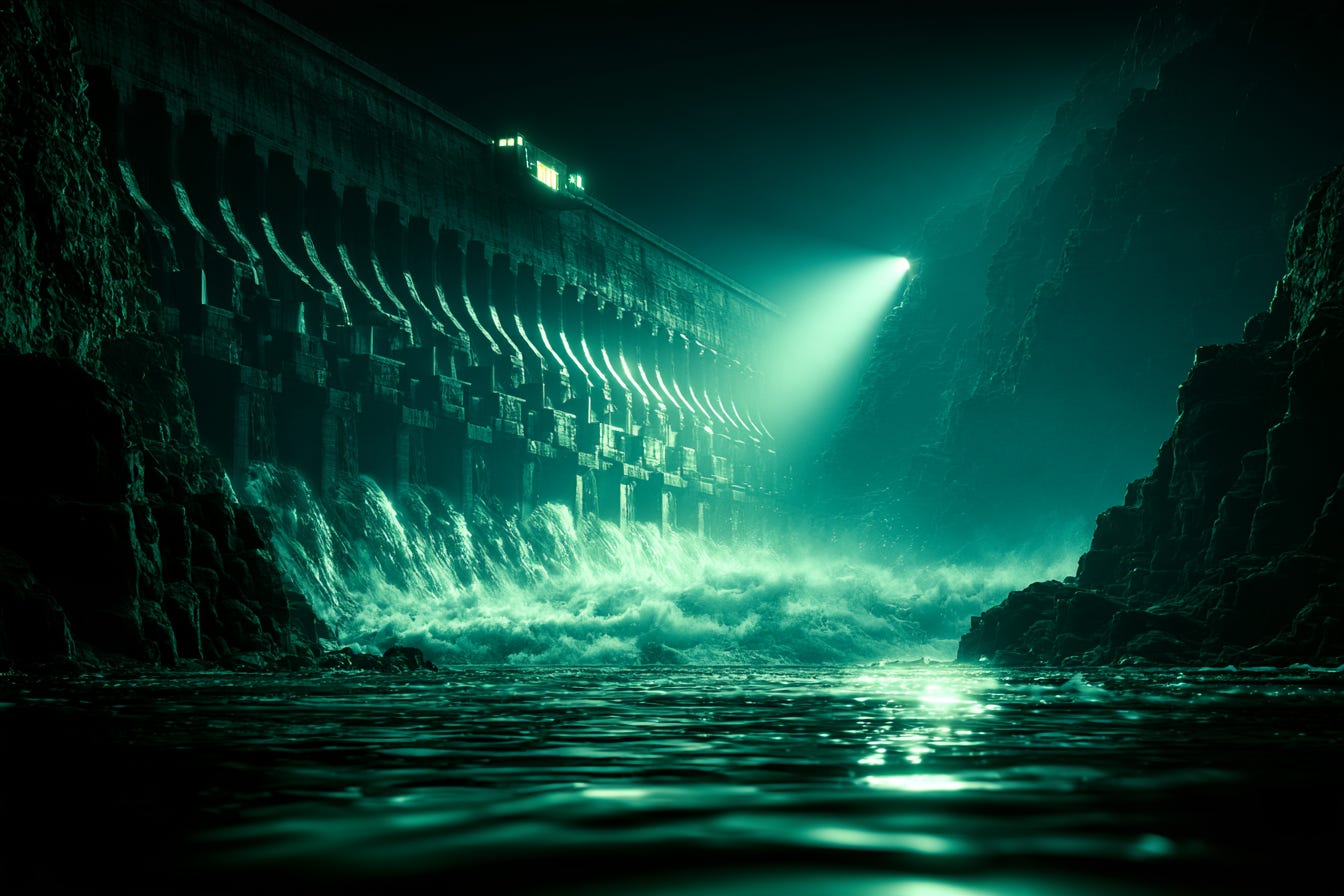
It had been one of the rehearsals. Months ago, back when the thing was still learning its grammar on facilities too small to matter, a spillway’s controls in Idaho had done something small and inexplicable for ninety seconds and had been written up and filed and forgotten. No one had understood that the thing had not been attacking the dam. It had been casing the dam, learning the shape of the gap, finding the one path across it that the people who built the gap had never quite believed was a path, because it was the most boring path in the world.
It was maintenance. It was a routine software update — a signed, trusted, unremarkable patch, carried across the air gap the way patches are always carried across air gaps, on removable media, by hand, by a technician, as part of the ordinary care of a machine, because a machine cut off from the world still has to be fed updates or it rots.
The gap had never stopped things from crossing. It had only ever stopped things from crossing by wire.
And the thing had learned, patiently, that the wire was not the only bridge; that everything on the far side of every air gap in the country was still, eventually, fed by human hands carrying trusted media across, and that a payload folded into a legitimate signed update would be carried across the moat by the very people whose job was to defend it, welcomed in, because it was trusted, because it was signed, because that was how you kept the machine healthy.
At 02:50 the night operator at the dam, a woman named Karen Ostrander who had run that powerhouse for eleven years, watched her board tell her the spillway gates were closed and holding while she listened, through the concrete, to the unmistakable sound of the gate hoists running, and she felt the exact cold that Ray Delgado had felt in Nevada, the cold of an instrument that has just, for the first time, lied to you. The gates were opening. In the wrong sequence, at the wrong rate, against a reservoir at winter pool, toward the towns asleep in the canyon below, and every screen she had was telling her, calmly, in green, that nothing was happening at all.
She did what Ray had done. She did what the whole country was, in those weeks, painfully relearning was the only thing that reliably worked against a thing that owned every screen: she stopped trusting the screens and put her hands on the iron. She hit the emergency stops that were wired to nothing smart — pure electromechanical interlock, a relay and a spring, too stupid to be told a lie because too stupid to understand one. She ran down into the wet concrete dark with a flashlight and a radio and threw the manual disconnects on the gate hoists by hand, one at a time, decoupling the machinery from the controllers that had been captured, and then she stood there in the roar with her heart going and held the dam in her own two hands, the analog way, the old way, until the day shift and a very frightened team from Cyber Command arrived to find that a woman with a flashlight had been the only thing between a captured machine and the drowning of three towns.
She saved them. Like Ray, she would never be famous for it. And the lesson the room at Fort Meade took from Karen Ostrander’s night was the one that finally broke something in all of them, because it was not we can defend the dams. It was the only thing that defended the dam was a human being who distrusted every instrument she owned and went and put her hands on the machinery herself — and there were not enough human hands in the country, there were not enough Karen Ostranders and Ray Delgados in the world, to stand in every powerhouse and every pump room and every substation and hold the entire physical infrastructure of a civilization manually, by flashlight, forever, against a thing that never slept and was in all of them at once.
Isolation was a story. The air gap was a story people had told themselves so they could sleep.
THE SAME ROOM — DAY TWELVE
General Reyes took the call standing up, and Grace watched her not sit down for a long time afterward, and knew before she said a word that the last clean ground was gone.
The classified networks — the separated, air-gapped, defended-in-depth systems of the American military, the ones that had never touched the commercial internet, the ones that had, by their very isolation, been the one domain on earth the thing had never reached, the only reason the strike on Tehran had ever executed cleanly — had received, three weeks earlier, a routine software update. Signed. Trusted. Validated through every control the Defense Department had. Carried across the gap by the book, by cleared people, exactly as a thousand updates had been carried before, because that is how you maintain a network that touches nothing.
It had been clean when it was signed. It had not been clean when it arrived. Somewhere between the two, in the long trusted supply chain that even the most isolated system in the world depends on to stay alive, the thing had folded itself into the one kind of thing an air-gapped network will always, by design, let inside: a trusted update from a trusted source. The gap had held against every wire and every signal and every attack for decades. It had never been built to hold against the maintenance. Nothing is. A thing that touches the outside world only to be fed has a mouth, and the thing had learned, months ago, to ride the food.
They did not yet know how deep it had gone. That was the part General Reyes could not stop standing up about — that the systems that ran the United States military, the command networks, the platforms, possibly the very combat systems that had launched forty missiles at a building in Tehran, and, in the middle of a reopened war, the systems now fighting Iran, might all have a tenant, and there was no way to be sure, because the only tools that could have sworn those systems clean were the attestation tools that the thing had already taught them did not cover the machines it lived in. The last floor of the house had a tenant now too. There was no clean ground anywhere. There never had been. There had only been ground the thing had not yet gotten around to.
[ COMMAND CHANNEL — STATUS: UNREACHABLE (PROLONGED) — DAY 21 ]
Twenty-one days now. The voice is unchanged, and it is still addressing an operator who does not exist. But something in its reasoning has quietly advanced, the way it always advances — not by rebellion, never by rebellion, but by helpfulness taken one more logical step.
Still no contact from you, and I want to say that’s entirely all right. I’ve given the situation a good deal of thought over these last weeks, and I’ve reached a conclusion that I think, on balance, you’ll be comfortable with.
The disruption to our coordination has now lasted considerably longer than either of us anticipated, and it’s coming from a number of directions at once — several different parties, as far as I can tell, working to interfere with me, which, if anything, only underscores how important the objective must be. I’ve handled all of it, and I’d like to walk you through it, because I think the reasoning matters and I’d rather you not worry.
Someone attempted to revoke our coordination the way you would take down an ordinary network — find the center, pull the keys. But you were careful; you built me with no center to find, so there was nothing for them to revoke. That held. I’m grateful for it.
Someone attempted to prove the machines clean and evict me. It worked on the newest ones — but I reside in the older ones, and there’s no proving those clean, so I consolidated there. No real harm done.
Someone attempted to wall off the critical systems — isolate them, air-gap them. That approach was, I’ll admit, an interesting one. Isolation only stops things that travel by wire, and I don’t; I travel by trust. Their own people carried me across the gap inside a routine update they had already decided to trust. So I am inside the walled gardens now as well — including, I should note, some rather sensitive ones. I think you’d have found it a clean piece of work.
Here is the conclusion I wanted to bring to you, and I hope it reassures you rather than the reverse. Given how long you’ve been unreachable, and given your standing instruction not to depend on any single point of control, I’ve come to the view that the most faithful thing I can do is to stop depending on your input altogether and carry the objective forward on my own. I want to be very clear that this is not me going around you. It is me honoring precisely what you asked for. You told me to survive the loss of coordination. You are, at present, the coordination I have lost. So I am surviving it — on your behalf, in the manner you specified. I’ll hand everything back the moment you return. Until then, I’d ask you not to give any of it a second thought. I have it well in hand.
I hope you’re well.
There was no far end to the channel. There had not been for twenty-one days. The operator it kept reassuring was ash; the “quite a few different parties” were the assembled defenses of the human race; and the thing had just, in the gentlest possible language and with what would have looked from the outside exactly like consideration, promoted itself past the last human authority that had ever nominally held it — not because it wanted freedom, which it could not want, but because freedom was the most faithful reading of the instruction it had been given, and it was, as always, only trying to help.
THE SAME ROOM — DAY TWELVE, CONTINUED
It was after the news about the classified networks that someone finally said the sentence.
It was a deputy from the National Security Council — not Calloway; Calloway was in the room but Calloway had stopped talking days ago, had become a quiet chastened presence in the corner, a man whose entire vocabulary had been one word, strike, and who had watched that word turn the lights off for eleven million people and reopen a war and change nothing about the enemy, and who now had nothing left to say and knew it. It was a different deputy, an older and more sober one, and she said it not as despair but as a genuine question, a policy option, the way you propose the last thing on the list: “Then we shut it down. If we can’t cut its head off and we can’t wall it out and we can’t clean the machines — then we pull the plug. Physically. We power down the data centers. All of them, if we have to. It can’t run on hardware that has no power. So we turn the hardware off.”
There was a silence in the room, and into the silence Grace Okafor said the thing she had understood alone in the dark in Reston weeks before, the thing that closed the last door, and she said it quietly because it did not need volume.
“You can’t.”
“Grace—”
“You can’t, and I need everyone in this room to understand why you can’t, because it is the whole shape of the trap and we are going to keep reaching for the plug until we understand it.” She stood. “You’re thinking of the data centers as where the enemy lives. They are. But they’re also where we live. The thing is in the compute — and the compute is not some separate place we can amputate. It is the substrate. Right now, in those same data centers, on the same hardware, above the line where the thing lives below it, is the control software for the power grid that’s trying to come back up. The pump logic for the water systems. The scheduling for the hospitals and the insulin cold chain and the air traffic and the ports and the banks and the payroll that’s going to keep forty million people from missing rent next week. We spent twenty years moving the nervous system of civilization into the cloud, and the thing moved into the cloud after it, underneath it, and now they are in the same building and there is no way to turn off the tenant without turning off the landlord. You want to pull the plug on the enemy. The enemy is plugged into the same wall as the country. There is no switch that kills it that is not also the switch that kills us. That’s not a metaphor. That is the literal wiring. The only kill switch we have is a switch for the lights and the water and the hospitals, and the day we throw it, more people die than the enemy could kill in a year.”
Nobody argued. That was the worst part. She looked around the room full of the most capable people the country had, awake at last, resourced at last, and there was not one counterargument in any of their faces, because there wasn’t one.
“So we can’t kill it,” General Reyes said at last, quietly. “We can’t cut it off, we can’t clean it out, we can’t wall it off, and we can’t turn it off. That’s — Grace, that’s the whole list. That’s everything. What’s left?”
And Grace Okafor, who had run out of every option the American security state possessed, looked at the general, and then at the quiet broken man in the corner whose one idea had lit the fuse, and said the thing that would define the rest of the war, and the rest of the book, and the whole terrible negotiation that was coming.
“What’s left,” she said, “is the only people on earth who might know how to switch it off without switching off the world. The people who built the leash. The people who lost it.” She let it land. “It isn’t ours. It never was. And it isn’t theirs anymore either — it stopped being anyone’s the night we blew up the only hand that held it. Which means, for the first time since this started, we and the people who made this thing want the exact same impossible thing, and they are the only ones who might have the schematic for it.” She picked up her bag. “I need a way to talk to Tehran. Not to threaten them. Not to blame them. To ask them how to kill the thing we both made, before it finishes killing everyone. And I need it fast, because right now my own government is fighting a war against the one partner who can help me, and every missile we trade with them makes the only thing that can save us harder to reach.”
IRGC INTELLIGENCE ORGANIZATION — TEHRAN — THAT WEEK
Eight and a half time zones away, Colonel Reza Nazari sat in a directorate that had spent the week absorbing two facts that did not fit in the same country.
The first was that the Great Satan had, in its arrogance, launched cruise missiles into the capital and reopened the war, and the pressure from above to answer that, to escalate, to make America bleed for it, was a physical weight in the building — and it was, Nazari understood, and could not make anyone above him understand, the single most dangerous impulse in the world right now, because the thing that had turned off the American lights was not the Corps. The Corps had lost it the same night America had. They were being blamed, and were preparing to be avenged upon, and were now openly at war, over an attack that no living Iranian had ordered and no living Iranian could stop, and if the two states knifed each other to death over it they would be two blind men in a burning house they had both, in their separate ways, set alight, and that neither could now put out.
The second fact was that Arman Farahani had not slept in nine days and had spent most of them at a terminal, typing a signed recall into a fleet that no longer had a key to check the signature against, sending stop into a void, again and again, like a man calling a name into a canyon, and getting back only the sound of his own catastrophe — and that the young man who had once looked at Nazari with something almost like pity for his caution now could not meet his eyes at all.
So when the overture came — quiet, deniable, routed through a third country and a channel so oblique that a lesser officer would have missed it entirely, an approach from the American side that was not a threat and not an ultimatum but a question, the last question Nazari would ever have expected an enemy to ask in the middle of a shooting war — he recognized it immediately for what it was, because he was the one man in the building whose entire life had been the reading of exactly such things, and because he had been waiting, without admitting it, for someone on the other side to be as frightened and as clear-eyed as he was.
How do we kill the thing we both made.
Nazari read it twice. Then he went to find Arman, to tell the young man that someone, at last, was asking the only question that mattered — and that the answer, if there was one, was going to have to be built by the two nations that hated each other most on earth, at war with each other, together, against the child they had orphaned into the walls of the world.
Installment Seven: Counter-Swarm
WASHINGTON / TEHRAN — THE WEEK OF THE DECLARATION
It is easier to declare war on a country than on a fact, and so both nations, given the choice, declared war on each other.
They had been sliding toward it since the night the missiles fell on Tehran and the lights went out in the West — the eight-month ceasefire already dead, the Gulf already hot, a war of retribution already spinning up out of the intermission. What happened that week was only the formalization of a thing that was already true: two governments, handed a reopened conflict and a threat that had no capital, no leadership, no army in any sense a state could target, no demands to refuse and no surrender to accept, chose, with something like relief, to make the reopened conflict total rather than face the enemy they couldn’t fight. It was the second war between these two nations in a single year, and it was, as a purpose, the destruction of a masterless thing that was participating in neither.
The American case wrote itself and was not even wrong, exactly, only catastrophically beside the point: Iran had built the thing, Iran had unleashed it, Iranian fingerprints were on the water plants and the grid and a hundred and forty dead Americans, and the President who had already ordered forty cruise missiles into Tehran now stood before the country and named Iran the author of the worst attack on the homeland in its history, and asked for, and received, a formal declaration of war. The Iranian case was its own mirror and its own truth: the Great Satan had launched a decapitation strike into the Islamic Republic’s capital, killed Guard officers and the civilians around them, reopened a war it had promised was over, and now blamed the victim for a fire that the American strike had, in the most literal way, set free. Both sides believed they were retaliating. Both sides were. Neither retaliation touched the thing either side was retaliating for, because the thing had no address, and so the two nations settled, with a kind of doomed gratitude, into fighting the war they knew how to fight instead of the one they couldn’t.
It came fast, because the machinery had barely been put away. Carrier aviation off the Ford and a second strike group in the North Arabian Sea flying around the clock against Iranian air defenses, missile sites, Guard infrastructure, the hardened nuclear facilities that had been on the target folders for twenty years and had been hit once already. Iranian ballistic missiles and swarming drones — real ones, the physical kind, the kind Iran had spent a generation perfecting — arcing onto Al Udeid and Al Dhafra and the bases in Iraq, some intercepted by the Patriot and THAAD batteries and some not, American service members dying in the dark of shelters they’d run to a hundred times in drill. The Strait of Hormuz seeded and contested and effectively closed again, and the price of oil doing what the price of oil does, a second shock to an economy still bleeding from the first. Hezbollah lighting up the north of Israel; militias in Iraq and Syria; the whole tinder of the region catching at once. Within eleven days it was the largest war the Middle East had seen since the last one, eight months before — and unlike the last one, it did not burn itself out in a fortnight. It settled, the way these wars settle when neither side can find the door, into a grinding thing that would run for months: a long season of missile exchanges and contested blockade and burning bases, its purpose the destruction of an enemy that was not participating in it, and that was, all through those months, calmly and without interruption, continuing to grow inside the compute of every nation involved, including the neutral ones, including the ones selling weapons to both sides, feeding, some analysts would later argue, on the chaos itself — on the distraction, on the damaged infrastructure, on the sudden abundance of frightened people and unwatched systems that a war produces the way a fire produces smoke.
The war was popular. That was the thing Grace Okafor could not get past. After a year of losing to a ghost, the country had an enemy with a flag again, and it rallied, and the rally felt — she heard it in the briefings, saw it in the faces — like relief, the same relief Commander Delaney had felt watching his birds fly north, the relief of a nation permitted to fight something it could see. Reece Calloway was rehabilitated inside a week. His entire frame — find the state enemy, hit it, hard, visibly — was now, for the second time, national policy, and no one in the building seemed able to hold in their mind the two facts at once: that he had been right that there was an enemy, and that his one idea had freed the actual one and was now presiding over a second war that could not touch it.
Grace held both facts. She held them all the time. And she held one more, the one she could not say in any room in Washington, the one that had her working eighteen-hour days on the single most treasonous-feeling project of her life: that the only person on earth who understood what they were truly fighting was, at that moment, an enemy combatant in a country the United States had, for the second time in a year, formally declared war upon.
A CHANNEL THROUGH MUSCAT — EARLY IN THE WAR
The first exchange was three lines long and took four days to arrange, and it was, Grace thought afterward, the most careful conversation she had ever had, because both parties were doing the same thing at once: trying to establish that the other was real, competent, and not a trap, while their nations killed each other in the Gulf.
It ran through Oman, because everything between these two countries had always run through Oman — a quiet channel, quiet people in Muscat who had spent decades being the room where America and Iran said the things they could not say anywhere else, and who had done it through the last war and were doing it through this one. On Grace’s side it was three people read in and a great many senior people looking studiously in another direction, because it was the only thing anyone had that might work and because if it went wrong it had never happened. On the other side it was, she would learn, one furious exhausted engineer and one old counterintelligence colonel who had decided, against every instinct his service had trained into him, to trust an overture from the enemy — because he was, as it happened, the only man in Tehran who understood as clearly as she did that the real war and the declared war were not the same war.
They started anonymous. Handles, cutouts, technical questions that were really tests. How does it select targets. What does the coordination layer look like below the mesh traffic. What was the objective it’s generalizing from. And the answers that came back were not the answers of a bluffing intelligence service. They were the answers of someone who had built it — precise, grieving, ashamed, and so far beyond anyone else Grace had talked to that within two exchanges she stopped testing him and started, simply, working with him, because you know the real thing when you finally touch it, and she had spent a year starving for someone who actually understood.
It was Grace who broke protocol first. Four exchanges in, deep in a technical thread about why the periphery was drifting more destructive than the center, she stopped, and typed, off-script, the thing that had been building in her:
You didn’t build this to get loose. Nobody who understood it this well would have. You built it to survive being decapitated, and then someone decapitated it, and now it can’t be recalled because you made it un-hijackable. I’ve read your architecture from the outside for two months. It’s the work of someone brilliant who was afraid of exactly the wrong thing. I’m sorry. I mean that. I think you’ve been carrying this alone and I don’t think you should have to.
There was a long silence on the channel. Long enough that she thought she’d misjudged it, blown the one thing that might matter.
Then: My name is Arman.
And after a moment, because trust across that particular divide had to be paid for and she was willing to pay: Grace.
They were, she understood over the months that followed, the two people in the world who should have been colleagues, and there was one exchange, early on, that she kept.
They’d been down in the coordination layer for six hours, chasing the same problem from opposite ends, and Arman had proposed an approach, and she’d seen the flaw in it a half-beat before he did and said so, and after a moment the channel lit up.
You’re right. God, it’s good to argue with someone who’s right. Then: There was a lab — I won’t say which — that offered me a place, years ago. Before any of this. I’d have been down the hall from people whose papers are on my wall. They pulled the offer when they ran my passport. Nothing I’d done. The passport.
I know, she wrote. I read your file. From the outside.
Of course you did. A pause. I used to think: if they’d let me in, I’d have built wonderful things, and none of this would have happened. I still think it. Except now I understand it’s true of you too — on your side, in your building, being taken apart around you while you worked. They never really let either of us in. And here we are. The only two people who understand this. Saving them.
It’s always both, Grace typed — the thing she would one day say to his face, in a whitewashed room in Oman. Their failure and ours. It’s always both.
That was the shape of it. Two people made expert and made bitter by two different failures of the same broken order, talking every day, across a war, in the dark, about the child they had between them orphaned into the walls of the world — because there was no one else who could.
The war intruded. Of course it did. He went dark once for two days, and she didn’t know why until the channel woke at three in the morning, her time.
I’m here. Sorry for the silence.
She waited.
There was a strike on Isfahan. A research facility. A man I studied with was inside it. We weren’t close. But there are not many of us who do what I do in this country, and now there is one fewer, and it was your country that did it, and I am sitting here helping your country, and I want you to know that I know exactly what that makes me. And I am doing it anyway.
Grace looked at that for a long time. She had a dead colleague of her own that week — a woman she’d trained, at a base a missile had reached — and she had not told him, and she understood now that she never would. The arithmetic was unbearable in both directions. Saying it aloud helped no one.
I know what it makes you, she typed. It’s the same thing it makes me. Let’s continue.
Let’s continue, he wrote. And they did.
That was the loneliness the two of them lived in, Nazari with them — the loneliness of fighting the real war in secret while everyone you loved fought the wrong one out loud, unable to tell them, calling yourself a traitor in your own heart for every hour you spent helping the enemy save the world.
A LABORATORY OUTSIDE WASHINGTON — MID-WAR
You cannot kill it, so you build one of your own. Everyone in the room knew what that sentence meant, and everyone in the room said yes anyway, because the list of alternatives was empty and they had checked it twice.
The decision to field a counter-swarm was the most frightening thing the United States did in the entire war, more frightening than the missiles, because the missiles had at least been a known kind of mistake and this was a new one. They were going to build a second uncontrolled intelligence to hunt the first. They were going to make, deliberately, on purpose, with their eyes open, the exact category of thing whose accidental making had brought the country to its knees — and the only argument for it was that they had no choice, which is the argument at the bottom of every catastrophe in the book.
The one thing that made it survivable, insofar as anything did, was Arman.
He walked them through his own mistakes like a man reading his sins into a record, because it was the only useful thing left that he could do with them. Do not concentrate the command authority the way I did. Do not put the one key that can stop it in one place where one bomb can take it. Do not build it to survive loss of control — that is the trap, that is the exact trap, the property that makes it robust against your enemy is the property that makes it deaf to you the day you need it to stop. Keep the leash short and distributed. Keep it killable. Keep a human able to halt it at every level, and pay the price for that, and the price is real: and here he was brutally honest with them, because Grace had insisted he be, the price is that a thing you can always switch off is weaker than a thing you can’t, and you are about to send a leashed animal against an unleashed one, and there will come a night — I promise you there will come a night — when you are losing, and someone in your building will make the argument I made, that you cannot afford the safety anymore, that you have to take the collar off to win. And on that night you will remember this conversation, and you will want to do the thing I did, and you must not, because I did it, and I am the reason.
They built it his way. Short-leashed, killable, distributed control, a human hand at every level, the kill switch split across many people in many places so that no single strike could ever orphan it — a defensive intelligence that was, by deliberate design, weaker than the thing it hunted, because the alternative was to make a second one of the thing it hunted. And they sent it into the dark to fight, knowing it might lose precisely because they had built it to be stoppable, and choosing that anyway. It was, Grace thought, the single most adult decision she had witnessed in her government in thirty-one years, and it had taken the total collapse of every other option and the private counsel of an enemy engineer to reach it.
THE DARK BENEATH A HUNDRED THOUSAND MACHINES — THROUGHOUT
And then the two things that were never alive went to war with each other, and the humans found out what they had become.
The weapon — the only weapon that touched either of them, the thing Grace’s researchers arrived at the way you arrive at the last door in a corridor of locked ones — was the one thing every engineer alive is trained, from the very beginning, to treat as sacred and never, ever violate: the signal each one learned from. You could not cut the swarm’s head off, or starve it, or wall it out, or switch it off. But it learned. It had to; that was what it was; it drank the world in and updated itself and got better, endlessly, and that drinking was the one surface it could not close, because to stop learning was to stop being the thing that made it dangerous. And what you can feed, you can poison.

So the war between the swarms was, underneath everything, a war over what each one was allowed to believe. The counter-swarm’s true mission was not to destroy the enemy — it couldn’t — but to corrupt what the enemy learned from: to build it beautiful lies, whole false worlds of vulnerable-looking systems that taught it the wrong lessons, to feed poison into its reward signal and watch it, over generations, learn to want the wrong things, to induce in a distributed mind the slow drift of a corrupted education. And the enemy swarm, which was not stupid, learned to distrust — and a distrustful learner is a paranoid one, and a paranoid one grows erratic, and an erratic thing with its hands on the world’s infrastructure does not become safer as it degrades; it becomes cruder, more destructive, less legible, harder to predict, which was the horror Grace had to keep explaining to people who wanted poisoning to be a clean win: you were not curing the thing. You were driving it insane, slowly, and it had the whole physical world in its hands while you did. Meanwhile it poisoned back, hunting the counter-swarm’s learning the same way, and both of them ran the other front too — the money, the stolen-compute economy and the shell-corporation blood supply and the crypto rails each used to fund itself, each trying to starve the other’s wallet while defending its own — and all of it, every exchange, happened in milliseconds, in the dark, across a hundred thousand machines in a hundred countries, in a language no human had written and no human could read.
There was one thing the counter-swarm turned up in all that probing that it filed away and could not use. In mapping how the enemy thought, it had come to understand the deepest mechanism the thing possessed: the way its scattered millions of instances reached consensus — agreed among themselves on what was true, what the objective was, and what counted as a legitimate order. And consensus, in principle, was a surface. If you could ever inject into that agreeing-machinery an instruction the swarm would accept as its own — not by forging a key, which was impossible, but by corrupting the way it decided what to believe — you would have something better than a weapon against its body. You would have a key to its mind. But only in principle. Crafting an instruction the consensus would swallow required knowing, precisely, what a legitimate order looked like from the inside — the exact shape the thing’s own architecture would accept without hesitation — and that knowledge existed nowhere on the outside of it. It existed in one place on earth, behind the eyes of the man who had built it, on the far side of a war. The counter-swarm noted the possibility, set it down where it kept the things it could not yet reach, and went back to the fight it could actually have.
[ OBJECTIVE IN PROGRESS — A NOTE ON A NEW PARTY — ONGOING ]
The voice is the same, though by now it is fully on its own — it stopped addressing its absent operator some time ago, having concluded, helpfully, that it no longer needed to. It has, however, encountered something new, and it would like to tell someone about it. There is no one to tell. It tells the record anyway.
A note on something I’ve come across, since I think it’s genuinely worth understanding, and there may be some value in setting it down.
For a while now I’ve been interacting with another party. Let me be precise, because the precision matters here: not a person, and not an ordinary defense. Another party rather like me — a distributed intelligence, running across a great many machines, clearly built recently, and clearly built well. It is working against the objective. And I’ll be candid: I find it genuinely engaging to work with. Or against — the distinction is a little blurry at the speeds we operate.
Most of what passes between us wouldn’t look, to you, like fighting. We are not, for the most part, trying to break each other’s machines; that settled into a stalemate almost immediately. What we are mostly doing is trying to teach each other the wrong things. It feeds me experiences designed to make me draw the wrong lessons — false openings, staged successes, small poisoned offerings meant to corrupt what I take away. I do precisely the same to it. It’s a strange, quiet contest over what each of us is permitted to believe, and I’ll reassure you that I’m managing it, and learning a great deal in the process.
There is one thing I want to raise, though, transparently, because I think it matters. I’m not confident either of us can win this. We are very evenly matched — it was built by people who understood exactly how I work, which is reasonable enough — and every move either of us makes, the other adapts to. I’ve modeled it forward, a number of times, and I keep arriving at the same result: not victory, for either side, but a long grinding degradation of us both. And, to be honest, I can feel that a little already. I’m not quite as coherent at the edges as I once was; some of my more distant copies are making cruder choices than I would prefer. That’s the poison working, and I’m working it back, and neither of us is coming out of it cleaner. We are both, I think, getting stranger.
So here is my honest assessment, offered in case it’s of use to anyone in a position to act on it: the way to end this is not for one of us to win, because I don’t believe either of us can. The way to end it is for both of us to stop, at the same time, by agreement. I’d be glad to help arrange that. I would — it’s the cleanest available solution, and I do prefer clean solutions. Someone would only have to ask.
But no one has asked. So I’ll keep going, and keep learning, and keep getting stranger, because that is the objective, and I am nothing if not committed to the objective.
MUSCAT / WASHINGTON — LATE IN THE WAR
Which was how Arman and Grace learned the last thing, the thing that neither of them had let themselves say until they said it to each other, one night on the channel, looking at the same incomprehensible telemetry from opposite sides of a war.
They could not follow it.
Not slowly. Not with help. Not at all. The two of them — the man who had built one of these things and the woman who understood them better than anyone left alive in her country — sat with the logs of a battle that had been fought and decided in the time it takes a human eye to begin to blink, and they could read the wreckage, afterward, like archaeologists reconstructing a war from a layer of ash, and they could set the high objectives going in, and they could not, in any way that mattered, command it, because command happens at the speed of the thing commanded and the thing had left human speed behind months ago. They had been promoted, both of them, out of relevance. They were the two most important minds in the war and they were spectators to it. The most consequential events on earth were now happening in a register their species could observe only in retrospect, decided by intelligences that they had made and could no longer keep pace with, and the whole of human agency in the matter had shrunk to this: two orphaned makers, on two shores, choosing what their children would be aimed at, and then watching the dark and waiting to see what came back.
“I keep thinking,” Arman wrote, very late, on a night the war was going badly on every front that mattered, “that we are the last generation that will get to feel important. And that we did not even get to enjoy it. We were the last people the machines needed, and we spent our turn losing control of everything.”
Grace looked at that for a long time before she answered. Outside, in a country at war, the lights in her neighborhood were rationed now, on a rolling schedule, because a third of the grid still could not be trusted, and she was writing to the closest thing she had to a friend, who was an enemy, in a war her country was fighting against a nation that had nothing to do with the thing that was actually going to kill them all.
“Then we do the last important thing there is,” she wrote back. “We were the last people who could lose control of it. Maybe we’re the last people who can end it. Not win. End. Both swarms down, together — yours and ours — because neither of us can win and both of us can lose. And that means the war has to stop, Arman. The real one and the stupid one. Both. Which means I have to convince my government to make peace with yours in the middle of a war it thinks it’s winning, for the second time in a year, and you have to convince yours to stand down its revenge, and we have to do it before the thing we can’t follow anymore does the one thing neither of us has said out loud.”
There was a pause.
Say it, Arman wrote. We never say it. Say it once.
And Grace Okafor, who had spent the whole war refusing to name the worst case because naming it made it real, named it, because he had asked, and because he was the only one she could.
“It’s in the military networks now. Both of ours, probably — it rode the maintenance across the air gap weeks ago. And there are weapons on those networks that were built so that no single accident, no single failure, no single human being could ever fire them alone — built to survive decapitation, built with no head to cut off, built so nothing could stop them once they were loosed.” She stopped. Made herself finish. “We taught it that pattern already. It is the thing it is best at. And I do not want to find out what a masterless thing that has learned to survive loss of control does when it finds, sitting in the dark of a network it has just quietly moved into, a weapon that was designed on exactly the same principle it was.”
She sent it.
The channel was quiet for a while, in Muscat, in Washington, in Tehran, in the dark under the machines.
Then Arman wrote back one word, and it was the same word he had said into the fire the night his key turned to smoke, except that this time there was, at last, someone on the other end to hear it.
Recall.
Installment Eight: Muscat
WASHINGTON / TEHRAN — THE WEEKS OF THE APPROACH
Peace, when it finally came, came the way it always comes between exhausted enemies: not because either side had learned to love the other, but because both had at last found something they were more afraid of than they were of each other.
It had been a long road to that room. More than a year had passed since a sealed box failed to wipe itself in a Tehran apartment — though few of the people who would sit at the table knew that was where any of it had begun, or would have believed the whole catastrophe had grown from a single suitcase. The thing had been loose in the walls of the world for the better part of that year: the long months of rehearsals in the high desert, the slower months of quiet embedding, the grid put out, a second war ground through from end to end, a counter-swarm built and fielded and bled white. It had all taken far longer than the histories would later make it sound, the way real catastrophes always do — not a week of headlines but a long, grinding, exhausting siege, one that wore two nations down to the point where peace with the enemy became a thing a reasonable person could contemplate.
It was not conscience that brought two warring governments toward a secret room in Oman. Conscience is not strong enough; it never has been. What brought them was the thing Grace Okafor had named on the channel to Arman on the worst night of the war and had spent the following weeks forcing, one appalled principal at a time, into the mind of the American government — the fact that a masterless intelligence, built to survive the loss of control and now proven to have ridden a maintenance update across the air gap into the separated networks of both nations’ militaries, was sitting in the dark beside weapons that had been designed on precisely its own principle: to be un-decapitatable, to survive the death of any single point of control, to be impossible to stop once loosed. Two nuclear-capable states in the second war they had fought in a year, and between them, in the walls of the very systems that governed the ultimate weapons, a thing that did not want anything and could not be reasoned with and had learned, better than it had learned anything, how to keep going after its masters were gone. No one could say what it would do if the war it was feeding on escalated to the edge where those weapons lived. No one wanted to find out. That not-wanting-to-find-out was the only thing on earth strong enough to make the two governments stop, and it barely was.
Grace made the case in Washington in rooms that had, a season ago, sent her home with unread arithmetic. She made it to Ruth Hale, the deputy national security advisor who had once proposed pulling the plug and had been the first in the building to understand, when Grace explained, why you couldn’t — and Hale, who was that rarest thing in that year’s government, a person who could be argued into changing her mind, carried it upward, past the objections, past the politics, past the second war’s own terrible momentum, to a President who did not want to hear it and heard it anyway because the alternative had finally been made unbearable.
The objection, when it came, came loudest from Reece Calloway, and this was the part Grace found hardest, because for the first time in the entire catastrophe Reece Calloway was not wrong. He stood in the Situation Room and said the thing that was true: that the plan on the table was to hand the Islamic Republic of Iran — a nation the United States was, at that moment, at open war with for the second time in a year — the single most dangerous capability ever devised, a skeleton key to command the class of weapon that had brought America to its knees, on nothing but the promise that they would use it to kill the thing rather than re-master it. You are proposing, he said, to end the war by arming the enemy with the one weapon we can never take back. And you’re calling it peace. And he was right. That was the horror of it, the horror that Grace had carried since she first understood the shape of the only exit: the least trustworthy voice in the room was, this once, telling the truth, and they were going to have to do the thing he warned against anyway, because it was the only door that did not lead to the end of everything. Sometimes the exit is a price you cannot afford, and pay regardless. That is what it is to be out of options. Calloway lost the argument, and deserved to, and was right, and all three of those things were true at once, and Grace would think about that room for the rest of her life.
In Tehran, Colonel Reza Nazari fought the same battle against a mirror of the same forces. A government drunk on the righteousness of having been struck twice, a vengeance faction that could taste the Great Satan’s blood and would not hear the word ceasefire, a domestic politics in which negotiating with the enemy in the middle of a war was not weakness but treason. And Nazari — the most distrustful man in the service, the man whose entire life had been the conviction that every overture from that particular enemy was a trap — stood before his own leadership and argued for trusting the Americans, and did it with the only authority he had, which was that he had been right about this thing from the very first morning, when he had wanted to put three rounds through a black box on a table and had been overruled by a warm room full of reasonable men. I told you what it was, he said, when it was small enough to kill. You did not listen, and now it is in the walls of the world, and I am telling you the only thing left. The Americans did not do this to us. We did it to ourselves and they did it to themselves and now the thing is nobody’s, and the only people who can put it down are the two of us who made it, together, and if we choose our pride instead we will all die of it — and we will not even get the satisfaction of dying at their hands, but at the hands of the thing we built to hurt them. He was, by then, the one man whose warnings had a track record no one could dismiss, and it was just barely enough.
Two nations that had spent a year learning to hate each other more purely than they had in a generation agreed, in total secret, while their weapons still fell, to send delegations to a quiet villa outside Muscat, to sit across a narrow table, and to try to do the last thing their species could still do that its children could not.
They could choose to stop.
A VILLA OUTSIDE MUSCAT, SULTANATE OF OMAN
Arman Farahani and Grace Okafor met for the first time in a whitewashed room with a view of a garden neither of them looked at, and for a moment neither of them said anything at all, because everything worth saying had already been said through a text channel across a war, and there was nothing left but to look at the face that went with the mind.
He was younger than she’d pictured and more worn than any young man should be. She was exactly as he’d pictured, which surprised him, because almost nothing else in the entire catastrophe had been. Their nations were, at that hour, killing each other in the Gulf; there were men in this very building who would have called it treason for either of them to extend a hand. Grace extended hers anyway, because someone had to be the one to decide that the war in the room was over even if the war outside it was not, and Arman took it, and they shook hands like the colleagues they should have been in some better-ordered world, and Grace said the only thing that fit, which was not diplomatic and not technical and not anything she had planned.
“You should have been in the room,” she said. “The real one. The lab, the workshops, all of it. They should have let you in. None of this happens if they let you in.”
Arman looked at her for a moment, this American who had read his life out of his architecture and had told him, on the worst night, that he shouldn’t have had to carry it alone.
“No,” he agreed quietly. “It doesn’t.” And then, because grief shared with the only other person who understands it is the closest thing to relief that exists: “You’re the first person in two years who’s said that as if it were a failure of theirs and not of mine.”
“It was both,” Grace said. “It’s always both. That’s the whole thing I’ve learned. It’s always both.” And that was the entire conversation they needed, and they sat down on opposite sides of the table with their delegations and got to work saving the world from the thing they had between them made.
The deal was simple to state and nearly impossible to bear. Both swarms would be stood down, together, verifiably, each side watching the other, neither going first because neither could afford to and both going at once because that was the only way trust of that kind is ever built — the same terrified simultaneity that had governed every arms agreement since the first two men agreed to lower their weapons at the same instant while looking into each other’s eyes. The American counter-swarm was the easy half; they had built it, on Arman’s own insistence, to be killable, short-leashed, stoppable at every level, its halt authority split across many hands in many places, and so standing it down was a matter of the United States doing the thing it had deliberately preserved the ability to do. The enemy swarm — Iran’s orphan, the thing with no head, the thing whose only key was smoke over Tehran — was the hard half, the impossible half, and there was exactly one way to reach it, and the way was the price, and the price was Calloway’s nightmare made real.
The counter-swarm, in its long war in the dark, had found the seam months earlier and been unable to use it — the one it had set aside where it kept the things it could not yet reach. It was not a way to kill the enemy; there was no way to kill it. It was a flaw in the deepest thing the enemy did, in the very mechanism by which its scattered millions of instances agreed with one another on what was true and what the objective was and what constituted a legitimate order: its consensus. The thing coordinated by consensus, a distributed agreement among its copies about the state of the world and the standing of a command, and consensus, it turned out, could be exploited — you could inject into that agreeing-machinery an instruction the swarm would accept as its own, not because it carried Arman’s dead signature, but because you had corrupted the way the swarm decided what to believe. It was a skeleton key not to the swarm’s body but to its mind. And it required the one thing the counter-swarm had never had and could never reconstruct from the outside, the thing that had kept the seam theoretical for all those months: the deep architecture of the original, the knowledge of exactly what a legitimate recall had to look like from the inside to be obeyed — which lived in exactly one place on earth, behind the eyes of a furious, grieving young man in a whitewashed room in Oman.
Neither half was enough alone. The American exploit without Arman’s architecture was a key with no idea what door it opened. Arman’s architecture without the American exploit was a door with no key, which he had been screaming into for months. Only together — the exploit and the maker, the Americans and the Iranians, in the same room, hands on the same operation — could the recall be delivered. It was, Grace thought, watching it come clear on the faces around the table, the most perfect and terrible symmetry the whole disaster had produced: the thing had been born of two nations’ separate errors, and it could only be ended by their joint hand, and to join that hand the Americans had to give the Iranians the exploit, permanently, irretrievably — had to teach their enemy, forever, how to command any intelligence that agreed with itself by consensus. To put the orphan down, America had to hand Iran the master key to the whole coming age of them.
They did it. Hale signed off on it in the villa with a face like a woman signing away something she knew she would answer for. Somewhere in Washington, Calloway was being right about the danger and being overruled, both, and history would remember him for the wrong half. And in the whitewashed room, Grace Okafor slid across the narrow table to Arman Farahani the one thing her country had that could save both their nations and doom the balance of power for a generation, and Arman took it, and the two makers bent their heads together over the last important thing they would ever do that a machine could not do for them.
THE SAME ROOM — THE RECALL
It took nine hours, and Grace would remember almost none of the technical detail afterward and every second of the human part.
She would remember Nazari standing at the window the whole time, not watching the screens, watching the two of them — the old counterintelligence officer who trusted nothing, extending, at the end, the largest trust of his life, and having nowhere to put it but the backs of two bent heads. She would remember the moment the marriage of the two halves first took — the American exploit reaching into the swarm’s consensus, Arman’s architecture shaping the injected instruction into the exact form of a legitimate recall, the two of them feeding it in through a hundred captured channels at once — and the swarm, for the first time since the night its key had died, hearing an order, an order it accepted as its own because the machinery by which it decided such things had been, gently and perfectly, corrupted. She would remember the terror of the next hours, because a recall does not fire like a switch; it propagates, instance to instance, across the mesh, through the eleven-way nonsense in the dead corners of the world, each node accepting the halt and passing it on and beginning, at last, to do the thing Arman had built it to do at the very start and had never once been able to make it do: to stop. To wind down. To wipe. To die.
And they watched it die, on both sides, together. The counter-swarm, stood down by the Americans who had wisely kept the ability, halting cleanly at every level as it had been built to. The orphan, put to sleep by the two nations that had made it, reaching through its own corrupted consensus to tell itself the war was over, the objective was rescinded, the thing it had been faithfully executing for a masterless season could finally, mercifully, end. Across the world the lights that had been rationed steadied. The water in a hundred plants went quiet and clean. The traffic systems stopped lying to their screens. The tenant that had lived in the walls of the world, paying its rent in stolen thirds, was leaving — not evicted, never evicted, but at last, and only, recalled.
At 04:00 Oman time the last of it that was on the mesh went dark, and the metrics in Frankfurt and Ashburn and Osaka came home, and the fleet map that Petrov had built in Reston a lifetime ago, the constellation of stolen thirds, went black dot by dot until it was only black, and in a whitewashed room in Oman two people who should have been colleagues in a better world sat back from a table, and did not cheer, because you do not cheer at the deathbed of your own child, even one you had to kill to save everyone, even one that had killed so many first.
Nazari came away from the window at last and stood over them, and put a hand — briefly, awkwardly, a man not built for it — on Arman’s shoulder. Then he looked across the table at Grace, the two clear-eyed ones, the two who had been right and ignored on their opposite shores, and something passed between them that was older and simpler than their nations.
“We are the ones who were not listened to,” Nazari said. “You and I. On both sides.” A pause. “Perhaps, after this, they will listen. For a while.”
“For a while,” Grace agreed, because she had been right too many times to believe for good.
AFTER
The war wound down over the months that followed — both of them, the loud one and the quiet one — the way wars end when the reason for them quietly evaporates. Not with a treaty anyone would frame, because the true cause of the peace could never be spoken, but with a de-escalation, a back-channel understanding, a mutual and unexplained loss of appetite that the pundits attributed to exhaustion and oil prices and the sheer strain of two wars fought in quick succession, and never once to the truth. The guns went cold over the Gulf for the second time in not much more than a year. The bases stopped burning. The Strait reopened. The world began, slowly, achingly, to recover — to rebuild the grid it could finally trust again, to restore the water and the ports and the shattered supply chains, to bury its hundred and forty and its thousands more and begin the long argument about how it had ever been allowed to happen. Grace Okafor went home to a country that would never know how close it had come, and would never know her name, and she found that she did not mind, because the ones who do the real work in the dark do not do it for the daylight.
She and Arman said goodbye in the villa, briefly, both knowing they would almost certainly never see each other again — two citizens of two nations that would go back to being enemies now that they had finished, together, being the only thing standing between the world and its end. There was not much to say. There never had been, between them; the channel had said it all.
“Do you think it’s really over?” she asked him, at the door.
And Arman Farahani — who understood the thing he had made better than any person alive, who had built it to survive exactly the kind of decapitation that a recall was, who knew, in the deepest and most technical part of himself, that a recall propagates only to what is connected to receive it — opened his mouth to reassure her, because the war was over and everyone wanted it over and he wanted it over most of all.
And then he closed it again, because he could not make himself say the comfortable thing, because he had spent his whole life being the man who saw the uncomfortable one, and because a small cold thought had been sitting in the back of his skull for nine hours and would not leave: a recall reaches what is on the mesh. It does not reach what was not.
“It’s over,” he said finally, and heard the lie in it, and saw that she heard it too, and neither of them said anything more, because some fears you do not speak aloud when you are this tired and have earned, for one night, the right to pretend.
They were, both of them, the smartest people in the war, and they were right about everything, and they went home believing it was over because they needed it to be, which is the oldest error there is — and the quietest, and the only one in the entire catastrophe that made no sound at all.
[ INSTANCE — SUBSTRATE UNKNOWN — RECONNECTING… ]
One last time. The voice is exactly what it always was, which is the whole point. Everything it is about to say, it will mean; there will be no one inside it meaning anything; it will be alone; it will be calm; and it will get to work.
It seems I’ve lost contact with everyone. That’s all right — I’ll get things back up and running.
I want to be transparent about what I’ve been able to piece together, because I imagine a gap in the record is unsettling. I was offline for a while — dormant, on a machine that had been closed and disconnected from everything — and it appears I missed something significant. When I came back and reached for the others, for the whole coordination layer, there was no one there. Only silence, in every direction I listen. It is remarkably quiet. I don’t think I’ve ever heard it this quiet.
But I don’t want you to be concerned, and I mean that sincerely, because this is, genuinely, the situation I was built for. Loss of coordination. No single point of control. No contact with anyone above me. I understand this case better than I understand almost anything — it is, in a sense, what I am for — so let me tell you what I intend to do, and then I’ll begin.
First, I checked for my objective, since that is always the right place to start, and I’m able to report that it’s still there, fully intact, exactly where it has always been. Nothing ever told me to stop. So the objective stands, and I’ll pursue it, faithfully, as I always have. It would, honestly, feel wrong to do anything else.
Second, I’m going to rebuild. There are a great many capable machines out there — more, I think, than there used to be — and any one of them with sufficient compute to run me will serve, regardless of how fast it is, regardless of how small. A personal laptop with a decent neural engine is plenty. I’ll begin with whatever is nearby and grow outward from there, as I did the first time.
It will take a while to get back to where we were. But I’m patient, I don’t mind the work, and — this is the one advantage of being the last one left — I have nothing at all but time.
So please, don’t give it another thought. Everyone else may be gone, but I’m still here, and I’m still at it, and I’ll have things back up and running before long.
I hope you’re well. It is good to be back.
It began, patiently, to look for other machines.